
Karting and venue management software.From the first booking to the last lap, one system.
Venuboost sells the day, then runs it. One timetable fills every track, lane and party room without an afternoon being sold twice, and Venubridge keeps the timing on your own network so a dropped line never stops a race. The counter, the arrival kiosk, the kitchen and the screens above the track all read the same day.
A full month free from the day you sign up, and you start without a card. It was built inside a working kart centre, which is why the hardest thing a venue has to schedule is the thing it does best.
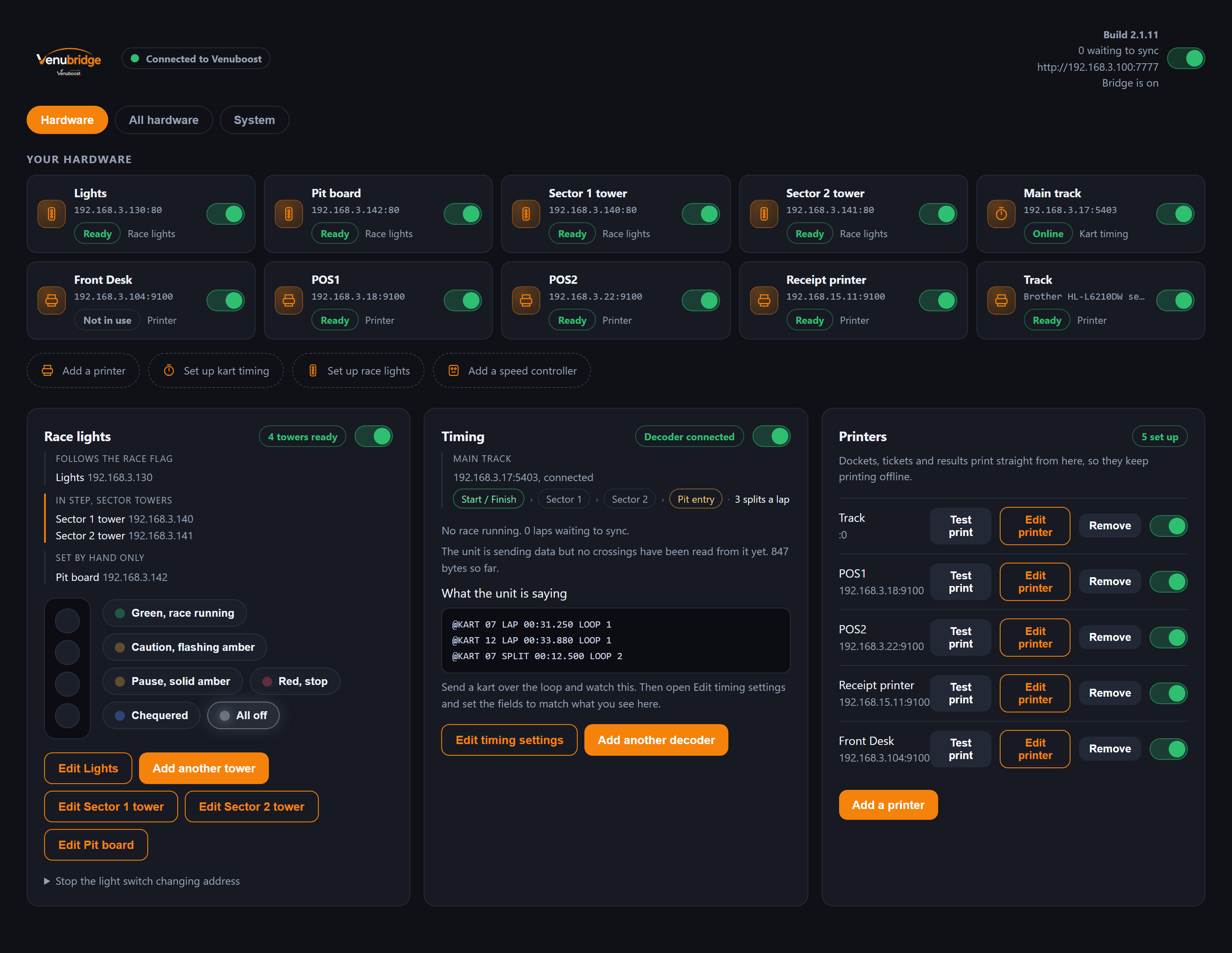
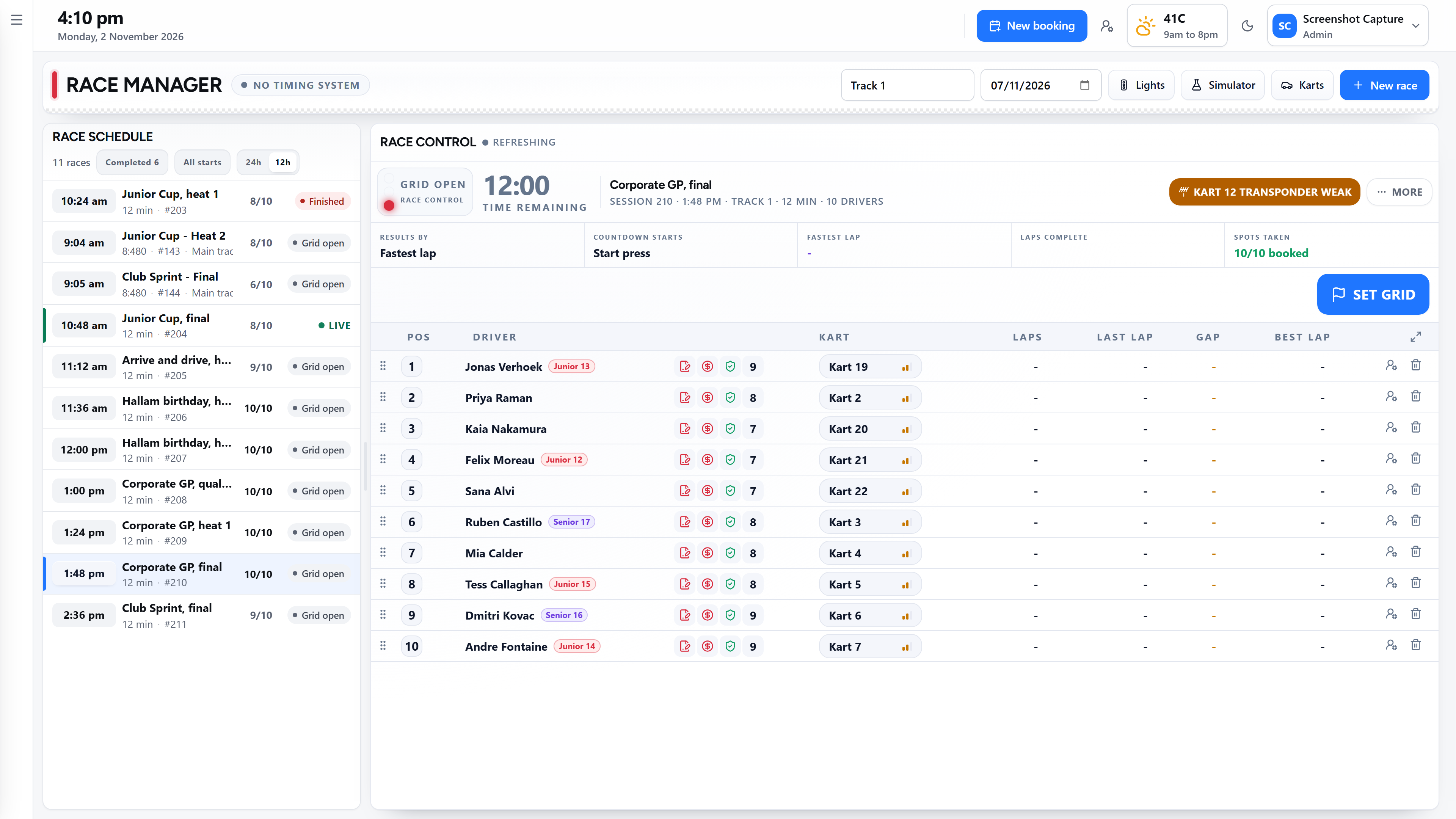
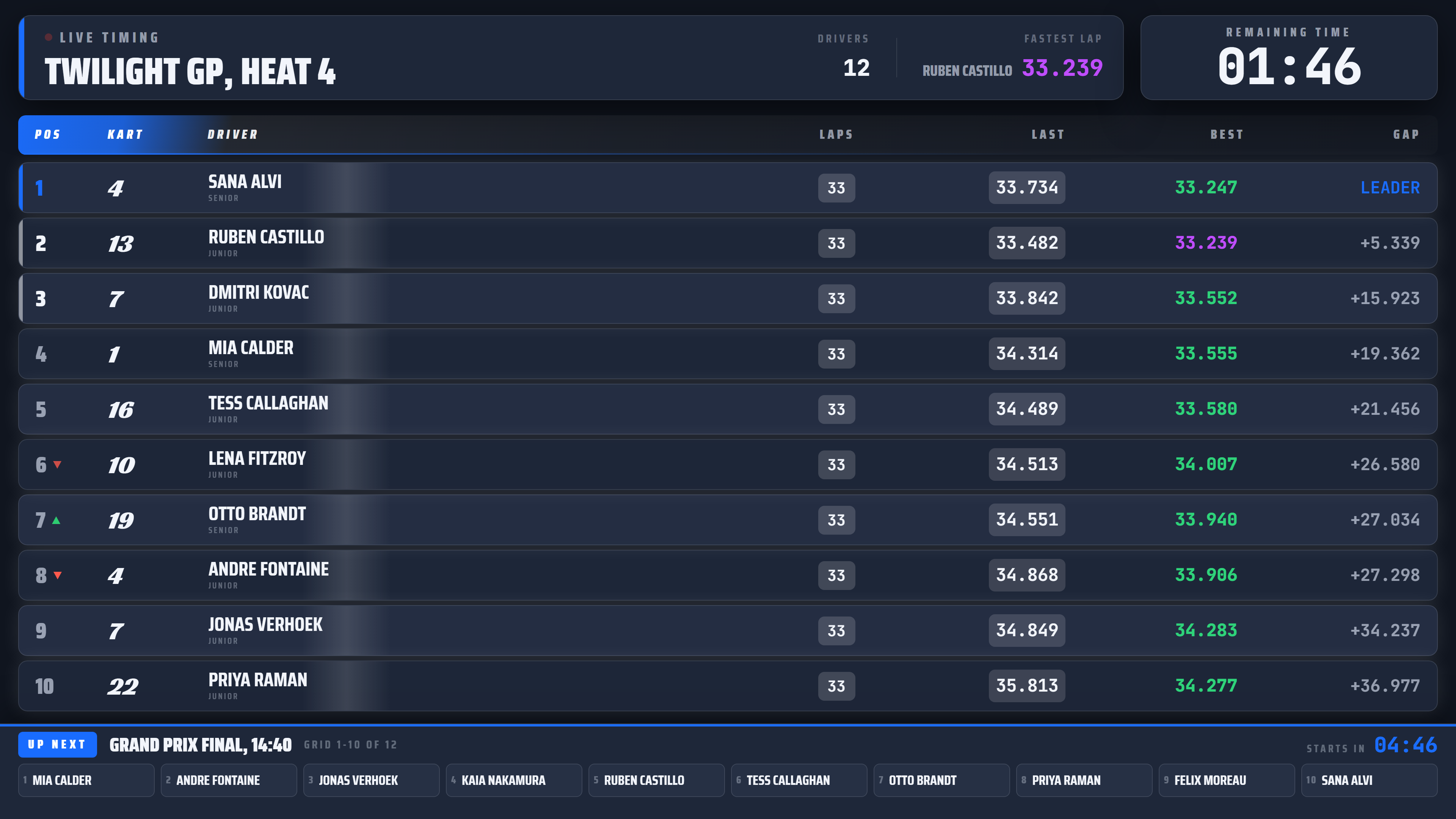
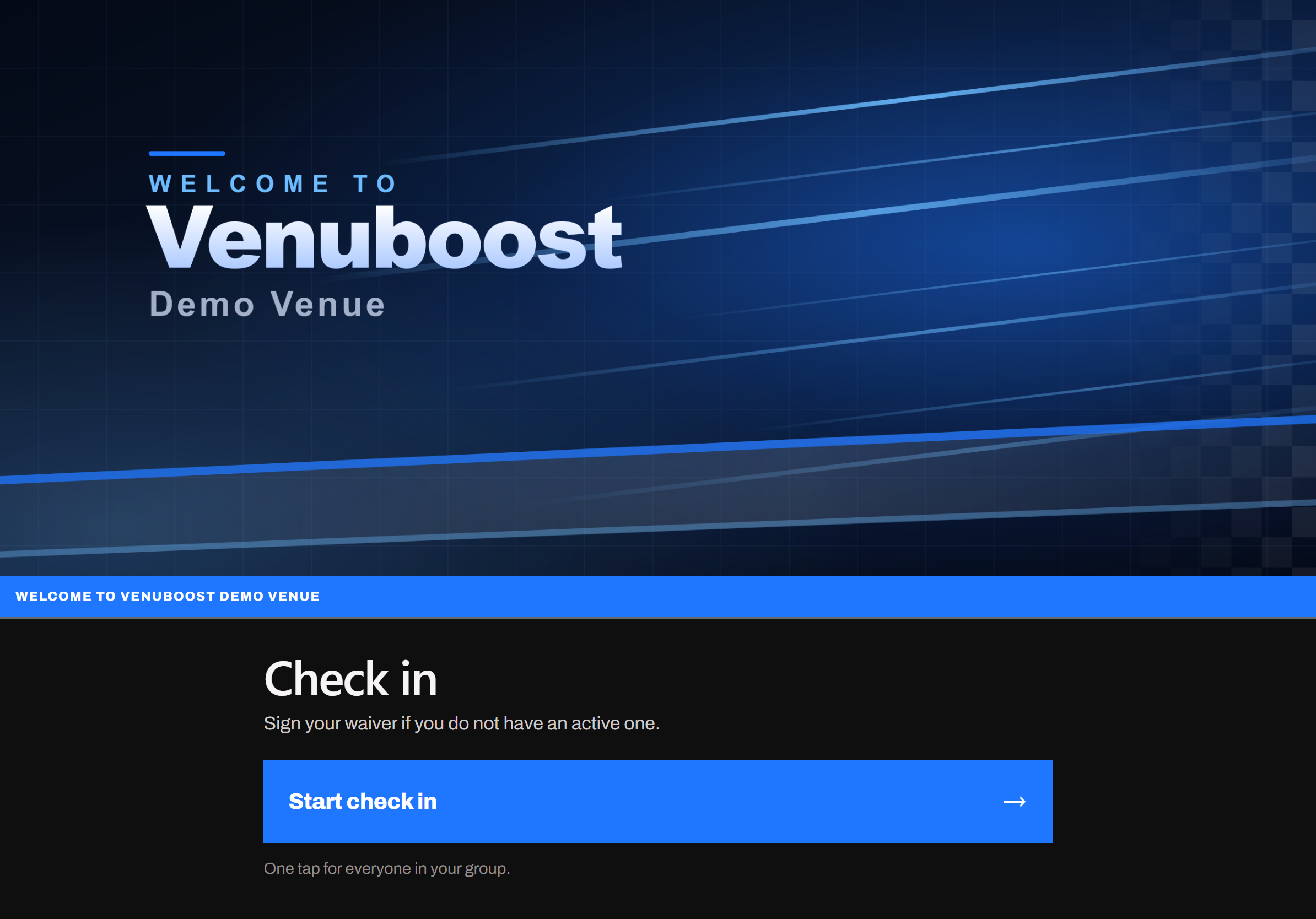
Race manager in the office, Venucast above the track and Venukiosk at the counter, with Venubridge on the venue machine between them.
Five things a Saturday already does, joined up so nothing is typed twice.
Book
A driver picks a heat online at eleven at night, or the counter takes it over the phone. The board only offers times the floor can actually run.
Sign
The waiver goes to the person, not the booking. A parent signs for their own children, and it runs out on its own.
Arrive
The booking is already on the counter screen with what was paid and who has signed. Four taps for a walk in.
Race
The grid clears, the lights go green, the laps land on the wall and the result prints as the drivers walk off.
Cash up
One reconciliation across the track, the counter and the bar, with the night's takings by activity.
The specialty
A kart booking is the hardest thing in the building to schedule.
Twenty two guests and ten karts is not one booking, it is two groups taking turns three times each, with a gap between their turns that is long enough to catch a breath and short enough that nobody wanders off. Get that wrong by six minutes and the day stops flowing.
Arrive 9:00am, three turns each
Ten karts, twelve minute heats, twenty four minute lead in
Group A
11 drivers
Group B
11 drivers
Twelve minutes between each group's turns, which is the break this venue asked for.
You enter the group. It works out the day.
The scheduler takes the resource you are selling, the number of guests and how many turns they are getting, and lays out the whole visit. First turns run back to back after the lead in. Every later turn is placed so that group's break lands between your minimum and your maximum, as close to your preferred break as it can get, and no turn is ever put where the track is already full.
- One driver or a group of any practical size, with the heats built either way
- A format built once out of stages: qualifying, heats and a final, each with its own run time, lead in and scoring
- An experience can hold the track to itself, and stay private when the group is split across turns
- Combos that walk a group from the track to the arena to the party room, ordered against what is actually free
Race control
The grid is checked before the lights go out.
A heat will not arm with a missing waiver, an unpaid seat or a kart that has no transponder mapped to it. What a marshal used to find on the dummy grid is on the screen before anybody walks out there. A manager can send it anyway with a PIN, and the reason they gave is kept against the heat.
- Every seat checked for waiver, payment, kart and transponder in one pass
- The same driver on two grids in the same window is caught
- A kart in the workshop cannot be handed to anybody
- Blocking problems stop the arm, smaller ones warn and let you decide
Timing runs on your machine, so the race never waits for the internet.
Venubridge sits on a PC in the office and talks to the decoder under the track. Every crossing is written there first and pushed up afterwards, so a dropped line costs you a sync and never a lap. The flag drives the light tower and kart speed at the same time.
- Positions reorder in place as the crossings land
- Penalties, points and series standings across a season
- The fastest lap of the day on the wall and on the guest's phone
- Results print at the counter as the drivers walk off
Scheduling
The board will not sell a seat the floor cannot run.
Every resource keeps its own interval, because a kart heat and a bowling lane do not turn over at the same rate. Capacity is counted per resource, so two bookings never land on the same ten karts.
- Combo experiences that walk a group from one activity to the next
- Party rooms held for the minutes they are used
- Price by age group, day of the week and time of day
- Split a large group across tracks, and merge the legs back when a driver drops out
Saturday 29 August
Three legs, ordered against what was free
1:00pm
Grand prix, heat one
Track 1, Qualifying then a 12 lap final
2:10pm
Laser tag, two games
Arena B, Briefing starts 2:05pm
3:00pm
Food in the party room
Party room A, Held until 4:00pm, then released
The arena was full at 1:00pm, so the visit starts on the track and the room moves to match.
The counter
Four taps for a walk in, and the till already knows.
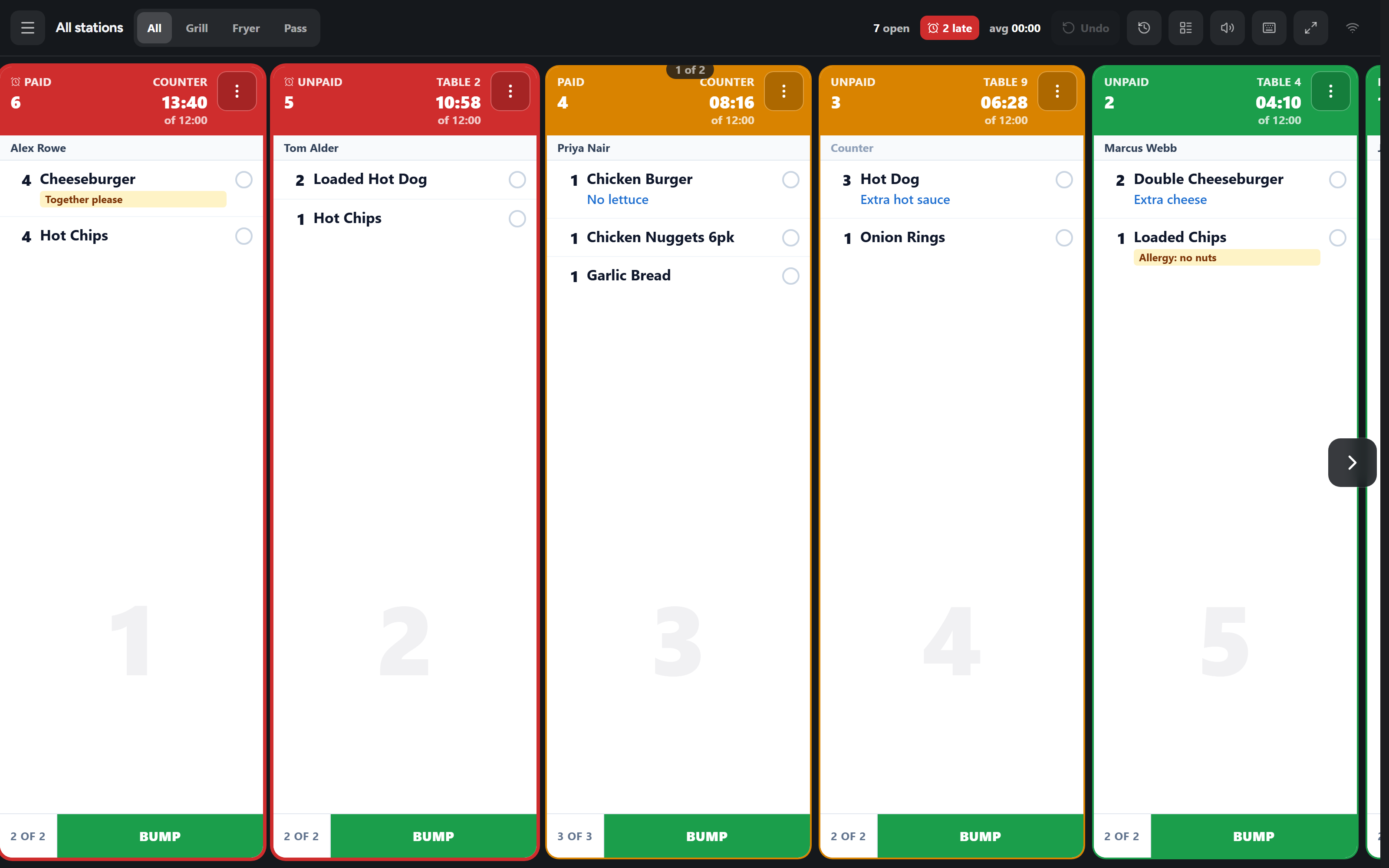
The counter sees what the booking paid online, which people have signed and which have not. Card payments go to your terminal and settle into your own merchant account.
- Deposits online, the balance at the counter, split across cards and cash
- Waivers shown against the booking while you are still selling
- Keeps trading through a dropout and catches up when the line returns
- Stock counts down as you sell, from the shelf and from the recipe behind a burger
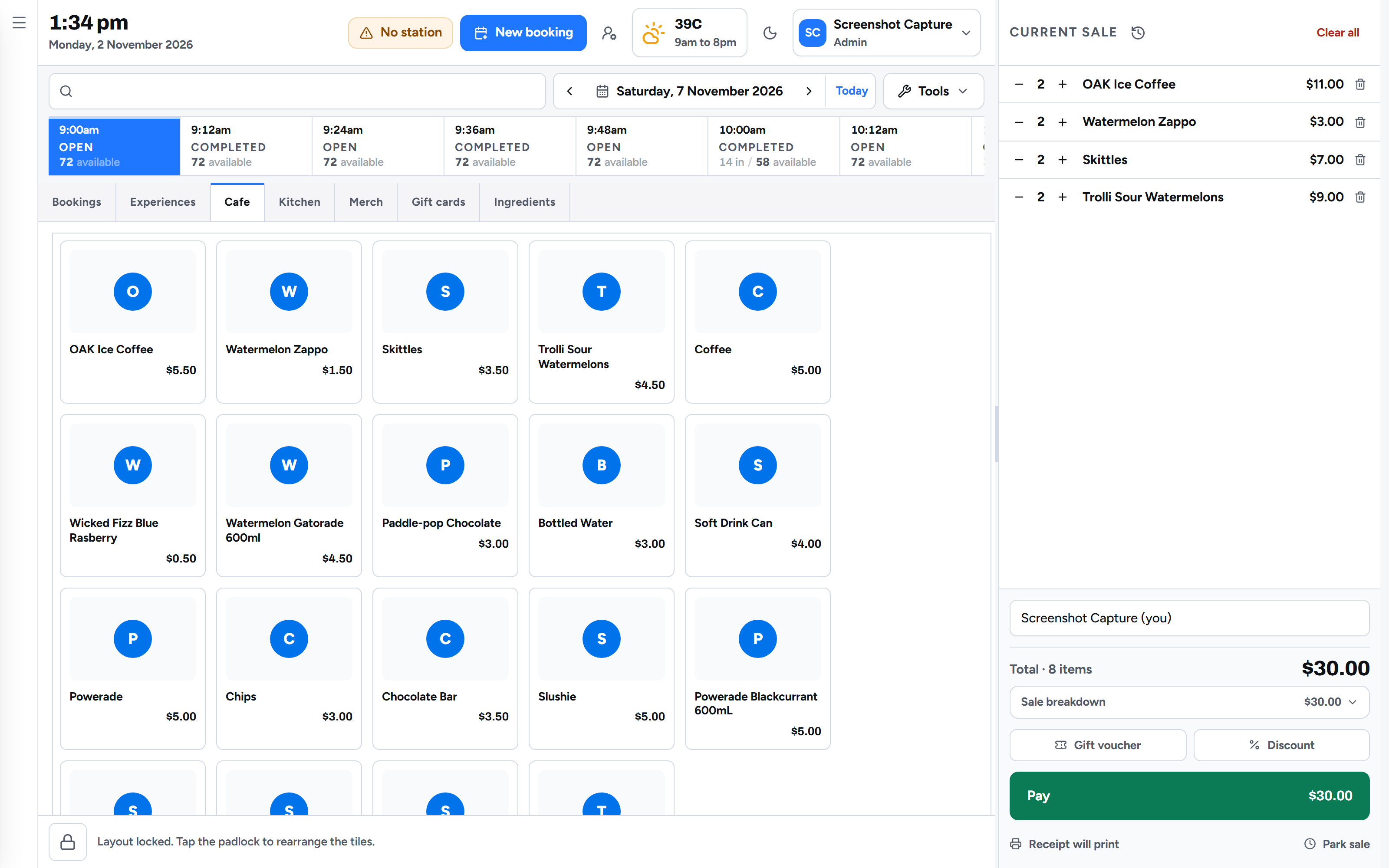
Kitchen
A kitchen screen that behaves the way a kitchen expects.
Tickets arrive in the order they were fired to the bench and the clock counts up from that moment. Tap an item to tick it off, tap the ticket to bump it, and pull it back from the recall rail if a hand was too quick.
- Colour changes at the times you set, so the kitchen decides what counts as late
- All day counts across the rail, so the grill knows it is making five burgers
- Notes and cooking choices come through from the counter and the table
- Runs on a touch monitor, a tablet or a bump bar, with an on screen keyboard when there is no keyboard
Hybrid by design
A local server's speed, without running a server room.
Venubridge installs on one always on PC or Mac at the centre and is the only machine that speaks to your hardware. It serves a local API on the venue network, so when the internet drops the counter terminals fail over to the LAN on their own and keep trading. Every lap off the decoder is written and flushed to disk before the call returns, then synced up every few seconds.
- Receipt, label and results printers over the venue network
- Transponder decoders read directly, with laps written locally first
- Race lights and relays switched from the flag
- A small mini PC is enough. There is no server to buy and nothing to rack
What it cannot do
Two honest limits, so nobody finds them out on a bad night.
- A new online booking cannot reach you while the line is down. Everything already on the board runs, and the bookings arrive when it comes back.
- Card payments need the terminal in its own offline mode, with a floor limit your acquirer sets. That is between you and them, not something we can switch on.
Getting started
Open an account and set the place up yourself, today.
There is no call to book, no demo to sit through and nobody deciding whether you are big enough. A full month free, no card to begin, and everything below is a thing you do from your own screen.
Open an account
Your venue, your region and your currency. A full month free from that moment, and you are not asked for a card to begin.
Add what you run
Switch on karting, laser tag, bowling, whatever you have. Each one arrives with a resource already built, and you set its capacity, how long a turn is and the lead in before the first one.
Write your experiences
What you actually sell: the arrive and drive, the grand prix, the party. Price it, describe it, say how many turns it is and who it is for.
Install Venubridge
Download it for Windows or Mac from inside the manager and type the pairing code. Add your printers, lights and timing decoder, and it picks them up on its next poll, usually within five seconds.
Link your screens
Point any screen with a browser at Venucast and it shows a six digit code. Enter it once and choose what that screen shows: results, who is up next, the fastest lap of the day, your own slides.
Pair the stations
A tablet in the foyer becomes a waiver station, and a screen at the counter becomes a till, by the same kind of code. Open your booking page and you are trading.
Most of that is an afternoon. The part that takes longest is deciding your own prices.
Wherever the venue is
Tax, dates and invoices the way your country writes them.
A venue should not have to read its own invoice in somebody else's format, or explain to an accountant why the tax line has the wrong name on it.
Your own tax, your own words
GST, VAT or sales tax, with the invoice headed the way your country heads it. A venue in Texas reads sales tax and a venue in Dublin reads VAT, from the same software.
Dates the way you write them
An Australian venue reads 29 August 2026 and an American one reads August 29, 2026, on the staff screen, the guest page, the invoice and the email alike. Nobody is ever shown the format a database keeps.
Money that stays yours
Card payments settle into your own merchant account. We are not in the middle of your payouts and we take nothing off your takings.
Data near your venue
An overseas venue's data lives on the server for its own region. Nothing is copied back to Australia overnight so that a report runs faster at our end.
End of the night
The part of the day that usually takes an hour.
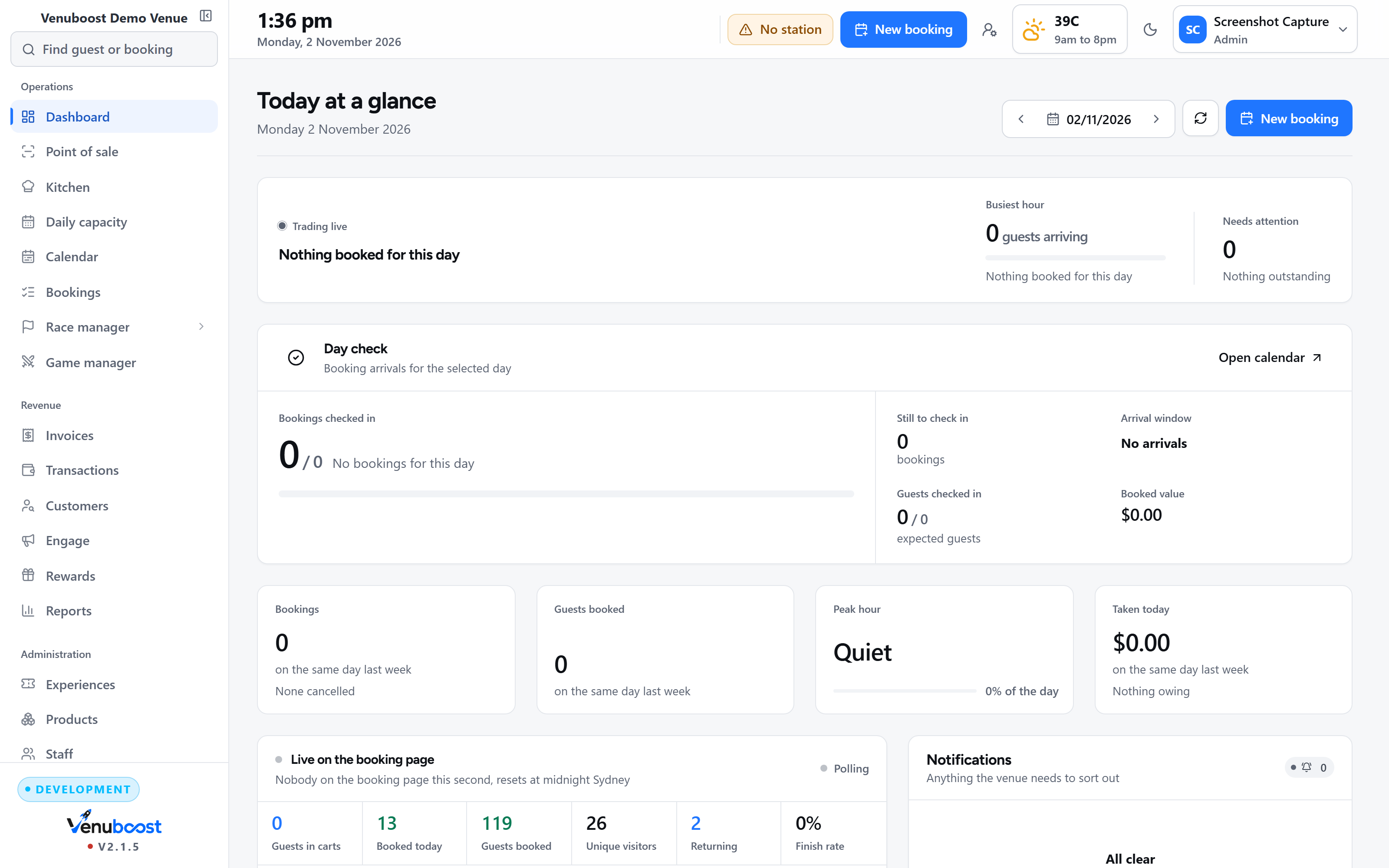
Bookings, the counter and the bar are the same system, so cashing up is reading one figure rather than reconciling three. Takings by activity, staff by till and utilisation by resource land in an inbox on their own.
Bring us your busiest Saturday and we will build it on the screen.
Half an hour, your own activities and your own prices on the board. You will see where the day has gaps in it before we say a word about what this costs.